Beginner Gym Workout: Your First Month Guide | ONIT GYM
Beginner Gym Workout: What Should You Do in Your First Month?
Starting the gym can feel harder than the workout itself. There are unfamiliar machines, dozens of exercises and plenty of conflicting advice online. Should you train every day? Start with cardio? Lift heavy? Copy someone else’s routine?
The good news is that your first month does not need to be complicated. A useful beginner gym workout should help you learn a small number of movements, build confidence with the equipment and establish a routine you can repeat. You do not need to train to exhaustion or use every machine in the gym.
This guide gives you a simple four-week plan, explains how to set up common gym machines and shows you when to increase the weight.
What Should Your First Month at the Gym Achieve?
In your first four weeks, success is not measured by how sore you feel or how much weight you lose. Your priorities are to:
- learn safe, repeatable movement patterns
- become comfortable adjusting and using gym equipment
- train the major muscle groups across the week
- find weights that challenge you without changing your technique
- build a schedule you can maintain
- recover well enough to return for the next session
Visible physical changes may take longer than a month. However, many beginners notice better coordination, more confidence and improvements in strength quite quickly. Treat your first month as the foundation for the months that follow.
How Often Should a Beginner Go to the Gym?
For most beginners, two or three full-body strength sessions per week is a practical starting point. Leave at least one day between sessions when possible—for example:
- Monday and Thursday; or
- Monday, Wednesday and Saturday.
Two consistent sessions are more valuable than planning five and regularly missing three. Current Australian movement guidelines recommend muscle-strengthening activity involving the major muscle groups on at least two days per week. You can also walk, cycle or do other enjoyable cardio on non-lifting days, but you do not need to turn every day into a hard training day.
Allow approximately 45–60 minutes for each session during your first month. If you only have 30 minutes, complete the warm-up and the first four or five exercises rather than rushing through everything.
A Simple Beginner Full-Body Workout
Perform this workout two or three times per week. Start with one or two working sets of each exercise. Most beginners do well with a weight they can control for 8–12 repetitions, finishing each set with roughly two or three good repetitions still possible.
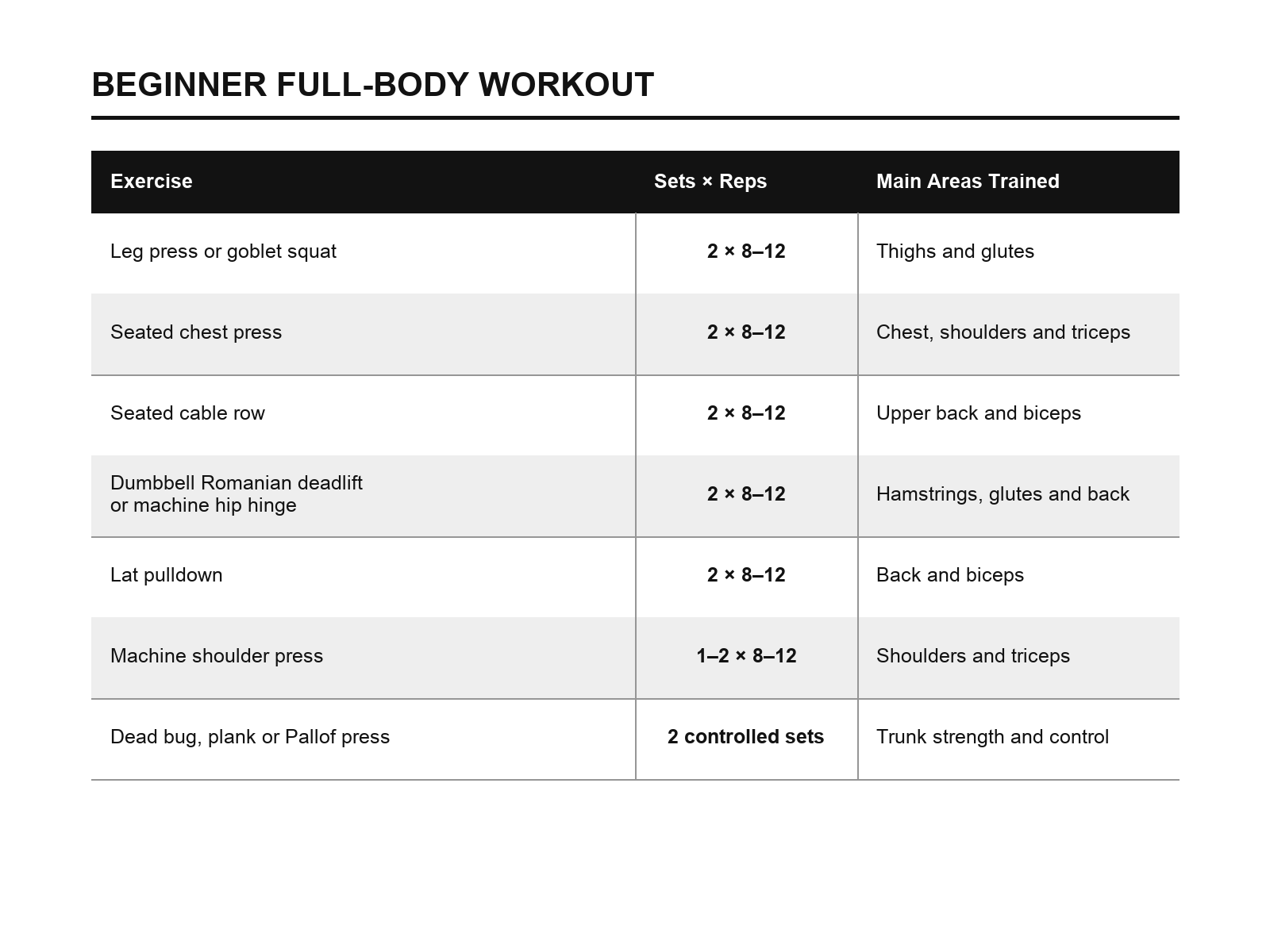
Rest for about 60–120 seconds between sets. Take more time if you are still breathing heavily or cannot perform the next set with good control.
This is a template, not a medical prescription. An exercise can be replaced if it causes pain, does not suit your mobility or cannot be performed confidently. A coach can help you choose an appropriate variation.
Your Four-Week Beginner Gym Plan
Week 1: Learn the Gym and the Movements
Complete two sessions. Use light weights and move slowly enough to understand what each exercise should feel like.
During this week:
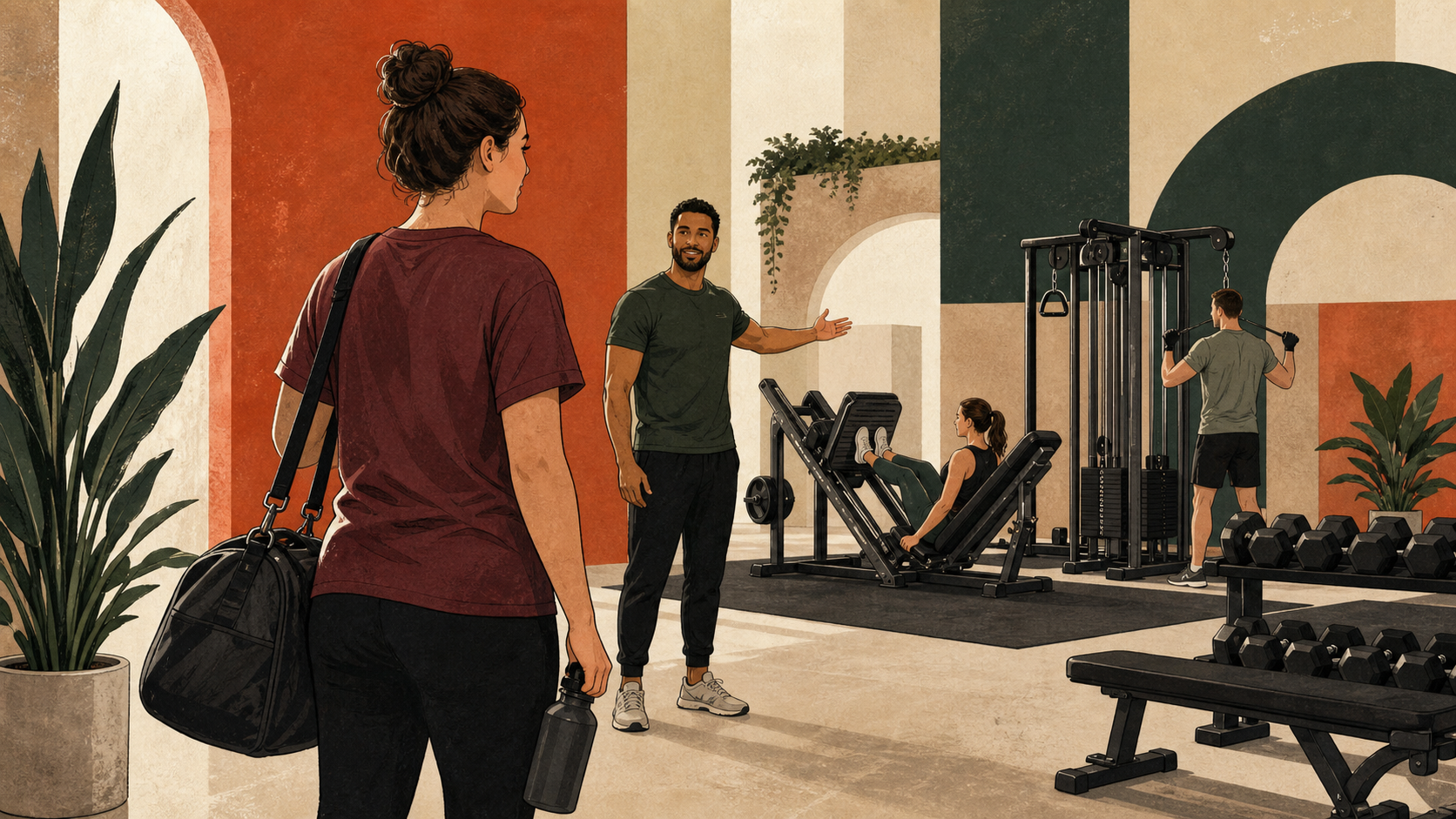
- ask a coach how to adjust unfamiliar machines
- record the seat setting and weight used
- practise the full comfortable range of motion
- stop each set well before your technique breaks down
- expect some mild muscle soreness, but do not chase it
Your goal is to leave the gym feeling that you could have done more.
Week 2: Repeat the Same Workout
Complete two sessions again, or add a third only if you recovered well from Week 1. Keep the main exercises the same. Repetition helps you improve technique and makes progress easier to measure.
If all repetitions felt smooth, add one or two repetitions to each set before increasing the weight.
Week 3: Add a Small Amount of Work
Continue with two or three sessions. Where appropriate, move from one working set to two, or add a small amount of weight to exercises that have become clearly easy.
Do not increase the weight, the number of sets and the number of training days all at once. Change one variable, then observe how your body responds.
Week 4: Build a Repeatable Routine
By Week 4, aim to complete two controlled sets of most exercises. Review your training notes and identify:
- which exercises now feel more natural
- where your technique still needs help
- which weights or repetitions have improved
- whether two or three weekly sessions fit your life better
The best outcome is a routine you are ready to continue—not a four-week challenge that leaves you exhausted.
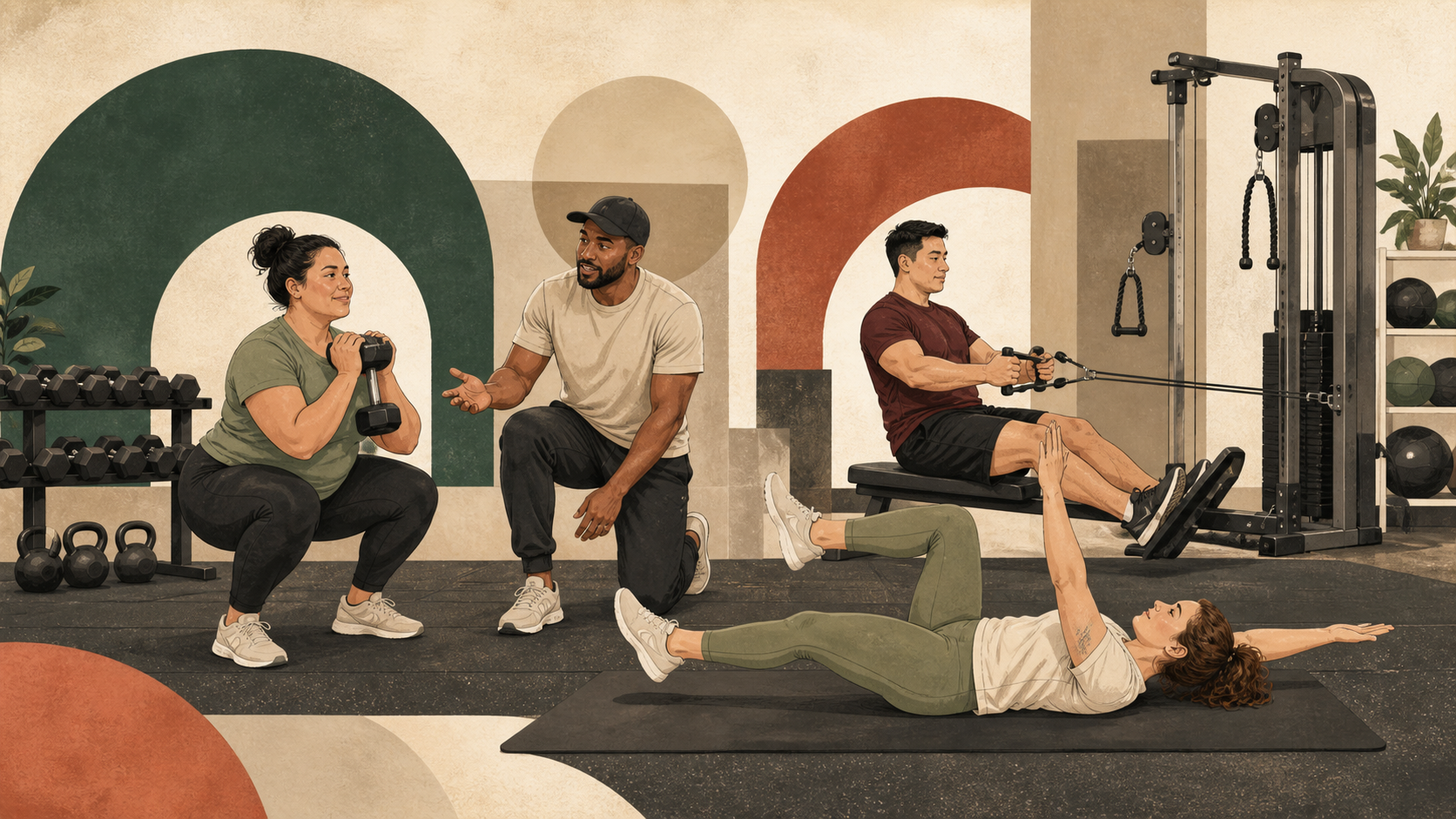
How to Use Gym Machines Safely
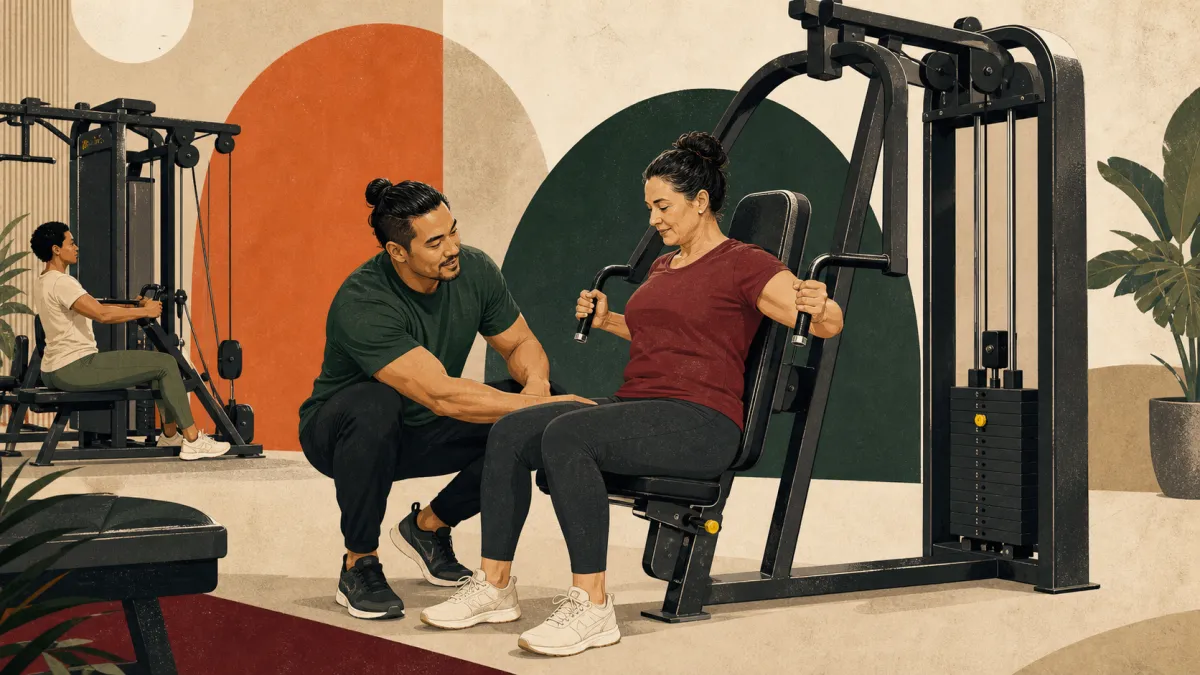
Machines can be an excellent starting point because they provide stability and make the movement path easier to learn. They are not automatically “safer” in every situation, however. The machine still needs to fit your body and be used with control.
1. Read the Diagram
Most machines show the target muscles, adjustment points and direction of movement. Check the diagram before sitting down.
2. Adjust the Seat Before Selecting a Heavy Weight
Line up the machine’s pivot point with the joint doing most of the movement where applicable. On a chest press, for example, the handles will usually begin around mid-chest height. On a leg extension or leg curl, the machine’s pivot should align reasonably closely with your knee.
3. Choose a Light Test Weight
Complete several slow repetitions. The movement should feel stable and controlled, without forcing a joint into an uncomfortable position.
4. Secure Pins and Attachments
Make sure the weight-stack pin is fully inserted. Check that cable attachments, safety stops and seat levers are secure before beginning.
5. Control Both Directions
Lift or push smoothly, then control the return. Do not let the weight stack crash between repetitions.
6. Ask Before Guessing
If you are unsure, ask a coach or staff member. A two-minute equipment explanation is more useful than trying to copy another gym member whose settings and goals may be completely different.
How Heavy Should a Beginner Lift?
Choose a weight that allows you to complete the planned repetitions with consistent technique. The last few repetitions should feel challenging, but you should not need to hold your breath excessively, shorten the movement or use momentum to finish.
A simple guide is to finish most sets with two or three repetitions in reserve. In other words, you probably could have completed another two or three good repetitions if required. Beginners do not need to reach muscular failure to make progress, and the latest ACSM resistance-training guidance notes that training to momentary failure is not consistently necessary for the average healthy adult.
Increase the weight only when you can complete the top of the repetition range for every set with good technique. Use the smallest available increase, then return to the lower end of the repetition range.
For example:
- Session 1: chest press, 20 kg, 2 × 8
- Later session: 20 kg, 2 × 12 with good control
- Next step: 22.5 kg, aiming for 2 × 8
Progress will not be perfectly linear. Sleep, stress, nutrition and your menstrual cycle, where relevant, can all influence how training feels on a particular day.
Should Beginners Use Machines or Free Weights?
Both can work. Machines may make it easier to learn how to apply effort to a target muscle, while dumbbells, kettlebells and barbells allow more freedom of movement and develop skill in stabilising a load.
You do not have to choose one side. A beginner program might combine a leg press, chest-press machine and cable row with a dumbbell squat or Romanian deadlift. The best equipment is the equipment you can use comfortably, progressively and consistently.
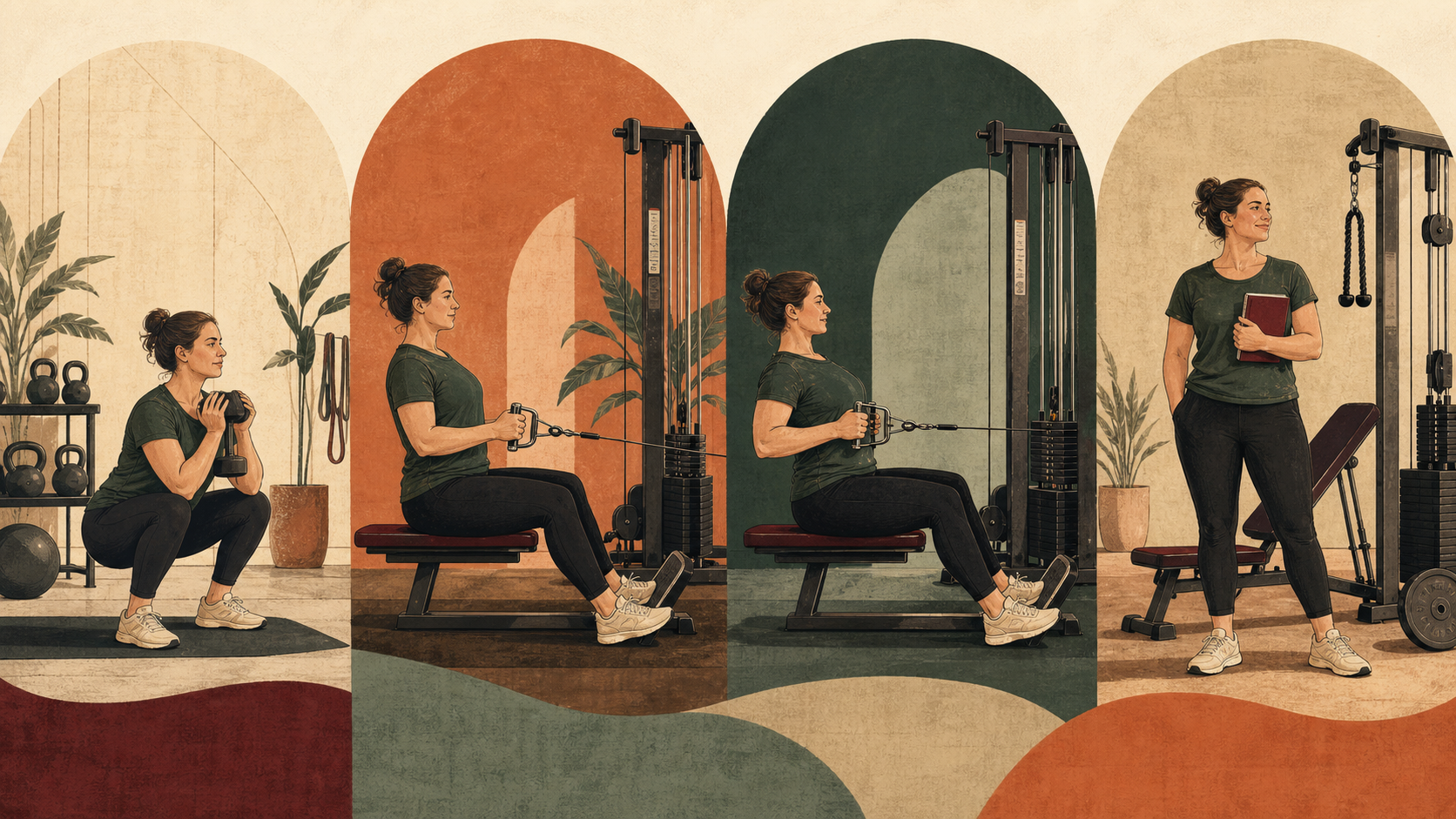
What About Cardio?
Cardio supports heart health, fitness and recovery, but it does not need to dominate your first month. You could begin each strength session with 5–10 minutes of easy walking, cycling or rowing, then include one or two separate easy-to-moderate cardio sessions if you enjoy them.
Keep the pace conversational at first. Gradually increase duration or intensity rather than starting with long, exhausting sessions. If strength is your priority, complete your main resistance exercises before hard cardio in the same session.
Common First-Month Mistakes
Doing Too Much Too Soon
More soreness does not automatically mean a better workout. Excessive volume can make normal movement uncomfortable and discourage you from returning.
Changing the Program Every Session
Variety can be enjoyable, but constantly changing exercises makes it difficult to practise technique or measure progress. Keep the main movements consistent for at least several weeks.
Copying Advanced Lifters
An experienced person’s split routine, weights or exercise variations were not designed for your current skill level. Follow a plan that matches your experience and goals.
Ignoring Pain
Muscular effort and mild post-training soreness are different from sharp, sudden or worsening pain. Stop the exercise if something feels wrong and seek appropriate professional advice when needed.
Judging Progress Only by the Scale
Body weight can fluctuate for many reasons. Also track attendance, technique, repetitions, weights used, energy and confidence.
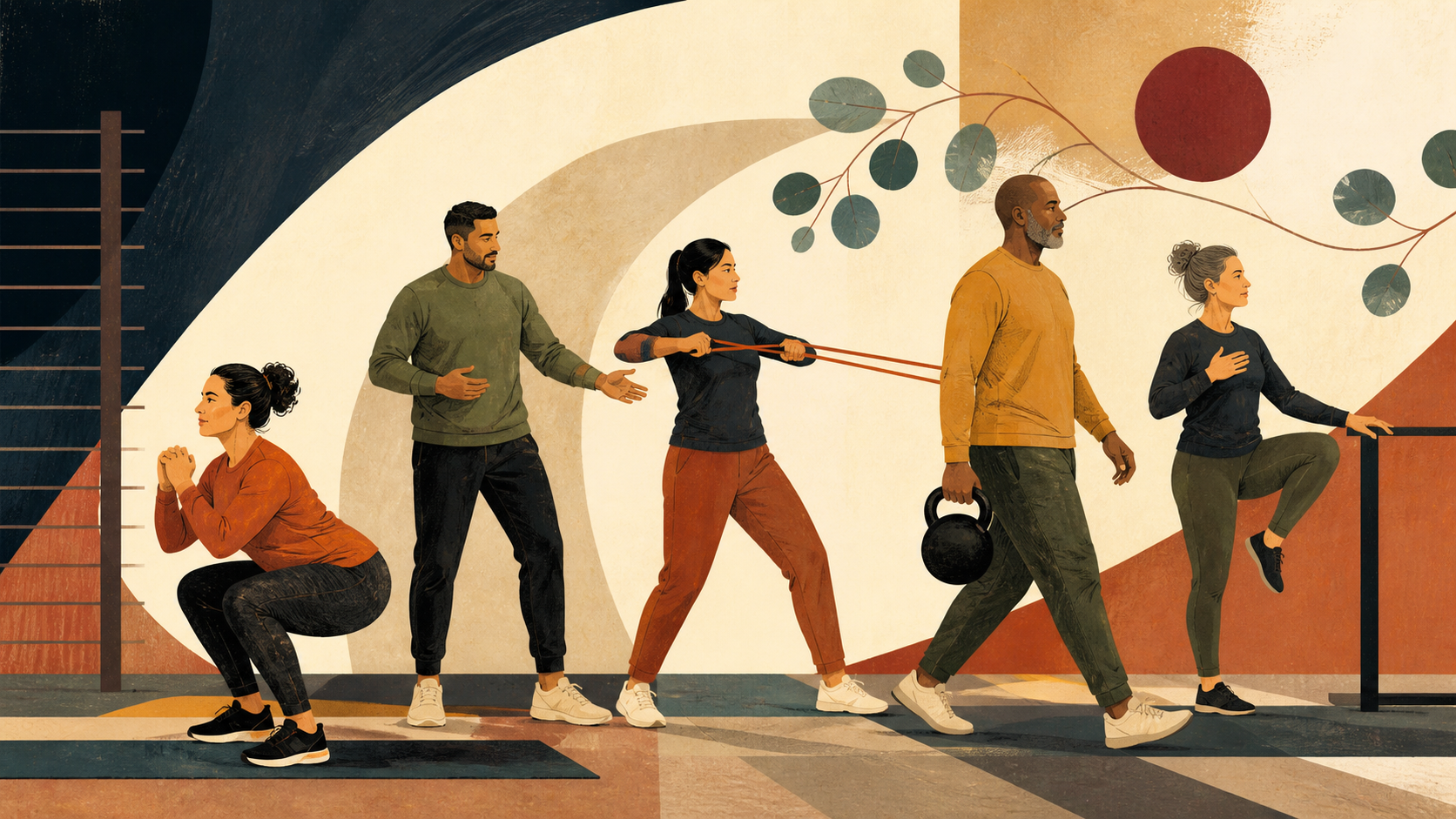
When Should You Work With a Coach?
Professional guidance can be especially helpful if you:
- feel anxious or unsure in the gym
- do not know how to adjust the equipment
- have a previous injury, health condition or persistent pain
- want feedback on lifting technique
- need a program built around a specific goal or schedule
- have trained before but struggle to stay consistent
A good coach does more than count repetitions. They help you understand what you are doing, why you are doing it and how to progress at an appropriate pace.
Your First Month Does Not Need to Be Perfect
The most effective beginner gym workout is one you can repeat. Start with two or three full-body sessions, use manageable weights, learn the equipment and record what you do. After four weeks, you should have a clearer idea of which movements suit you and how training fits into your week.
If you would like a plan built around your goals, experience and schedule, book a Free No Sweat Intro with ONIT Gym in Epping. We will talk through what you want to achieve and help you choose the most appropriate way to start—without expecting you to already know your way around the gym.
Frequently asked questions
1. Is three days a week at the gym enough for a beginner?
Yes. Two or three well-structured full-body strength sessions can provide an effective starting point. Consistency, appropriate effort and gradual progression matter more than training every day.
2. How long should a beginner gym session be?
Around 45–60 minutes is usually enough for a warm-up and a simple full-body workout. A focused 30-minute session can also be useful when time is limited.
3. Should beginners train when they are sore?
Mild soreness may be manageable, but severe soreness that changes how you move is a reason to rest or reduce the session. Sharp, sudden or worsening pain should not be trained through.
4. Do I need protein powder in my first month?
No. Protein powder is a convenient food product, not a requirement. A balanced eating pattern with sufficient protein, energy and fluids can support training and recovery. Individual nutrition needs vary.
5. When will I see results from the gym?
Some beginners notice better coordination or strength within the first few weeks. Visible changes in muscle, body composition and fitness vary considerably and usually require consistent training beyond the first month.
Evidence note: This article is informed by the [Australian 24-hour movement guidelines for adults](https://www.health.gov.au/topics/physical-activity/24-hour-movement-guidelines-for-all-australians/recommendations-for-adults-18-to-64-years), which recommend muscle-strengthening activity on at least two days per week, and the [American College of Sports Medicine’s updated resistance-training guidance](https://acsm.org/resistance-training-guidelines-update-2026/), which emphasises regular training of the major muscle groups and notes that complex methods or training to failure are not required for most healthy adults. Individual needs still vary.
Health disclaimer: This article provides general fitness information only and is not medical advice or an individual exercise prescription. If you have an injury, persistent pain, a medical condition, are pregnant or are returning to exercise after a long break, consult an appropriately qualified health or exercise professional before starting or changing your program.
Scientific sources and references
1. Currier BS, D’Souza AC, Fiatarone Singh MA, et al. (2026).American College of Sports Medicine Position Stand: Resistance Training Prescription for Muscle Function, Hypertrophy, and Physical Performance in Healthy Adults—An Overview of Reviews. Medicine & Science in Sports & Exercise, 58(4), 851–872. [PubMed](https://pubmed.ncbi.nlm.nih.gov/41843416/) | [Full text](https://pmc.ncbi.nlm.nih.gov/articles/PMC12965823/) | DOI: [10.1249/MSS.0000000000003897](https://doi.org/10.1249/MSS.0000000000003897)
Why it matters: This updated position stand supports training all major muscle groups at least twice weekly. It also concludes that many resistance-training approaches can be effective and that advanced techniques or training to momentary muscular failure are not consistently necessary for healthy adults.
2. Australian Government Department of Health, Disability and Ageing (2026).Australian 24-hour movement guidelines for adults (18 to 64 years) and older adults (65+ years). [Guideline report and downloads](https://www.health.gov.au/resources/publications/australian-24-hour-movement-guidelines-for-adults-18-to-64-years-and-older-adults-65years)
Why it matters: The national guideline recommends muscle-strengthening activity at moderate or greater intensity, involving all major muscle groups, on two or more days per week. It also emphasises that people who are currently inactive can gain benefits by starting with some activity and progressing gradually.
3. Currier BS, McLeod JC, Banfield L, et al. (2023).Resistance training prescription for muscle strength and hypertrophy in healthy adults: a systematic review and Bayesian network meta-analysis. British Journal of Sports Medicine, 57, 1211–1220. [Full text](https://pmc.ncbi.nlm.nih.gov/articles/PMC10579494/) | DOI: [10.1136/bjsports-2023-106807](https://doi.org/10.1136/bjsports-2023-106807)
Why it matters: The analysis found that resistance training prescriptions generally improved strength and muscle growth compared with no exercise. This supports using a simple, repeatable beginner program rather than waiting for a supposedly perfect routine.
4. Haugen ME, Tønnessen E, Seiler S, Haugen TA. (2023).Effect of free-weight vs. machine-based strength training on maximal strength, hypertrophy and jump performance: a systematic review and meta-analysis. BMC Sports Science, Medicine and Rehabilitation, 15, 103. [Full text](https://pmc.ncbi.nlm.nih.gov/articles/PMC10426227/) | DOI: [10.1186/s13102-023-00713-4](https://doi.org/10.1186/s13102-023-00713-4)
Why it matters: Direct comparisons did not show a clear overall advantage of machines or free weights for muscle growth. Strength improvements were partly specific to the equipment used, supporting the article’s recommendation to choose equipment according to comfort, goals and skill level.
5. Grgic J, Schoenfeld BJ, Orazem J, Sabol F. (2022).Effects of resistance training performed to repetition failure or non-failure on muscular strength and hypertrophy: a systematic review and meta-analysis. Journal of Sport and Health Science, 11(2), 202–211. [PubMed](https://pubmed.ncbi.nlm.nih.gov/33497853/) | DOI: [10.1016/j.jshs.2021.01.007](https://doi.org/10.1016/j.jshs.2021.01.007)
Why it matters: Training to failure was not required to improve strength or muscle growth when training volume was accounted for. This supports leaving some repetitions in reserve while a beginner is learning technique and managing fatigue.
6. Bastos V, Machado S, Teixeira DS. (2024).Feasibility and usefulness of repetitions-in-reserve scales for selecting exercise intensity: a scoping review. Perceptual and Motor Skills, 131(3), 777–800. [PubMed](https://pubmed.ncbi.nlm.nih.gov/38563729/) | DOI: [10.1177/00315125241241785](https://doi.org/10.1177/00315125241241785)
Why it matters: This review examines the use of repetitions-in-reserve scales to monitor and regulate resistance-training intensity. RIR is practical, but estimates are imperfect—especially for inexperienced lifters—so the “two or three repetitions remaining” recommendation should be treated as a learning tool rather than an exact measurement.